Electronics Service Dashboard
A Unified Operations Platform for Electronics Service Centers.
Technologies
Type
Client Project
Role
Solo Design & Development
Year
2025
Overview
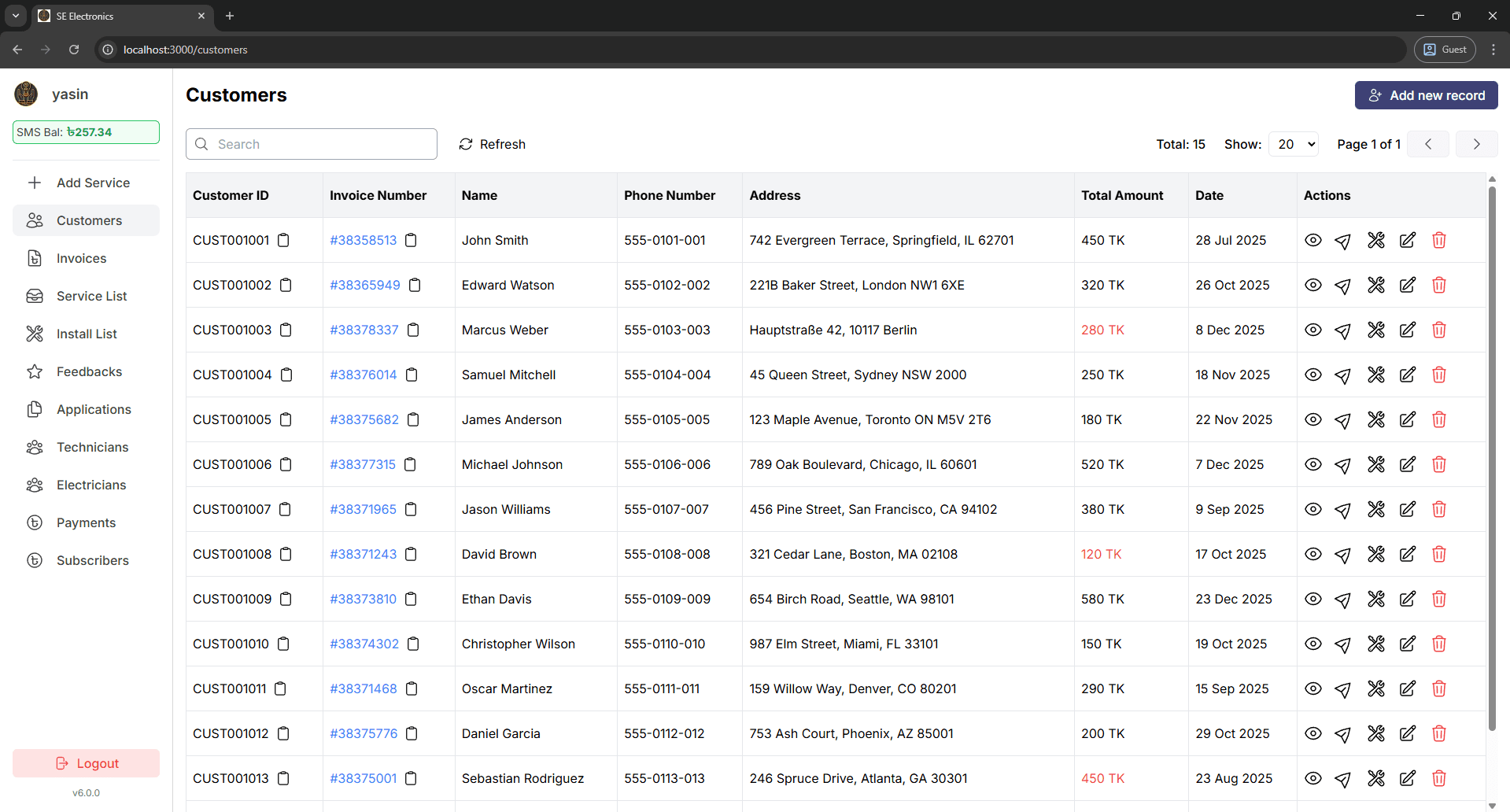
Electronics Service Dashboard is a purpose-built web application designed to streamline the complex operations of electronics service centers. Beyond just tracking repairs, it functions as a full-featured CRM that maintains detailed history of every customer interaction, from equipment purchases and warranty status to past service tickets and feedback. I built it to replace fragmented paper files with a unified digital platform that connects admins, technicians, and customers, ensuring that every repair and relationship is managed with transparency and precision.
Key Features
End-to-End Service Lifecycle Tracking
Tracks every repair job through a strictly defined state machine (Pending → In Progress → Staff Departed → Completed), providing a live, error-free view of the entire operation.
360° Customer CRM
Maintains a unified record of every customer, linking their contact details to purchase history, warranty status, and past service tickets, enabling personalized and informed support.
Automated Professional Documentation
Generates pixel-perfect PDF invoices, payment receipts, and staff ID cards with embedded QR codes on the fly, eliminating manual data entry and paperwork.
Digital Staff Verification & Onboarding
Features an integrated recruitment flow for technicians, complete with document uploads, background checks, and identity verification before assignment.
Smart Notification System
Automatically keeps all stakeholders in the loop via SMS alerts for critical events like appointment confirmations, status updates, and payment receipts.
Challenges
Generating Print-Ready Documents
The client needed invoices and ID cards to match their pre-printed stationery exactly. Standard PDF libraries couldn't handle the custom fonts, complex layouts, and barcodes required for this level of fidelity in a serverless environment.
Trustless State Management
With multiple stakeholders (admins, technicians, customers) modifying service requests, a simple status field was insufficient. We needed to prevent conflicting updates and track exactly who changed what to avoid operational disputes.
Handling High-Res Field Data
Technicians upload multiple high-resolution photos (proof of damage, warranty cards) from mobile connections. Storing raw images would explode storage costs and slow down the dashboard for admin reviewers.
Solutions
Headless Component Rendering
I built a micro-service using puppeteer-core to render React components as static HTML and snapshot them. This ensures 100% visual consistency between the web UI and the generated PDF without complex template engines.
Double-Write Ledger Pattern
I implemented a transaction-based system that simultaneously updates the current state and appends to an immutable ServiceStatusHistory log. This guarantees real-time speed for the dashboard while preserving a forensic audit trail for every action.
Cloudflare R2 & Optimization Pipeline
I integrated a server-side compression pipeline into the upload stream. It automatically resizes and converts images to WebP format before offloading them to Cloudflare R2. This reduced file sizes by ~80% and leveraged R2's zero-egress pricing, ensuring the platform scales without hitting bandwidth caps or incurring high storage bills.